
On commission from the Minister of Education, Culture and Science, the Cultural Heritage Agency of the Netherlands developed a vision and an atlas of the Atlantic wall. Both were presented at the end of 2024.
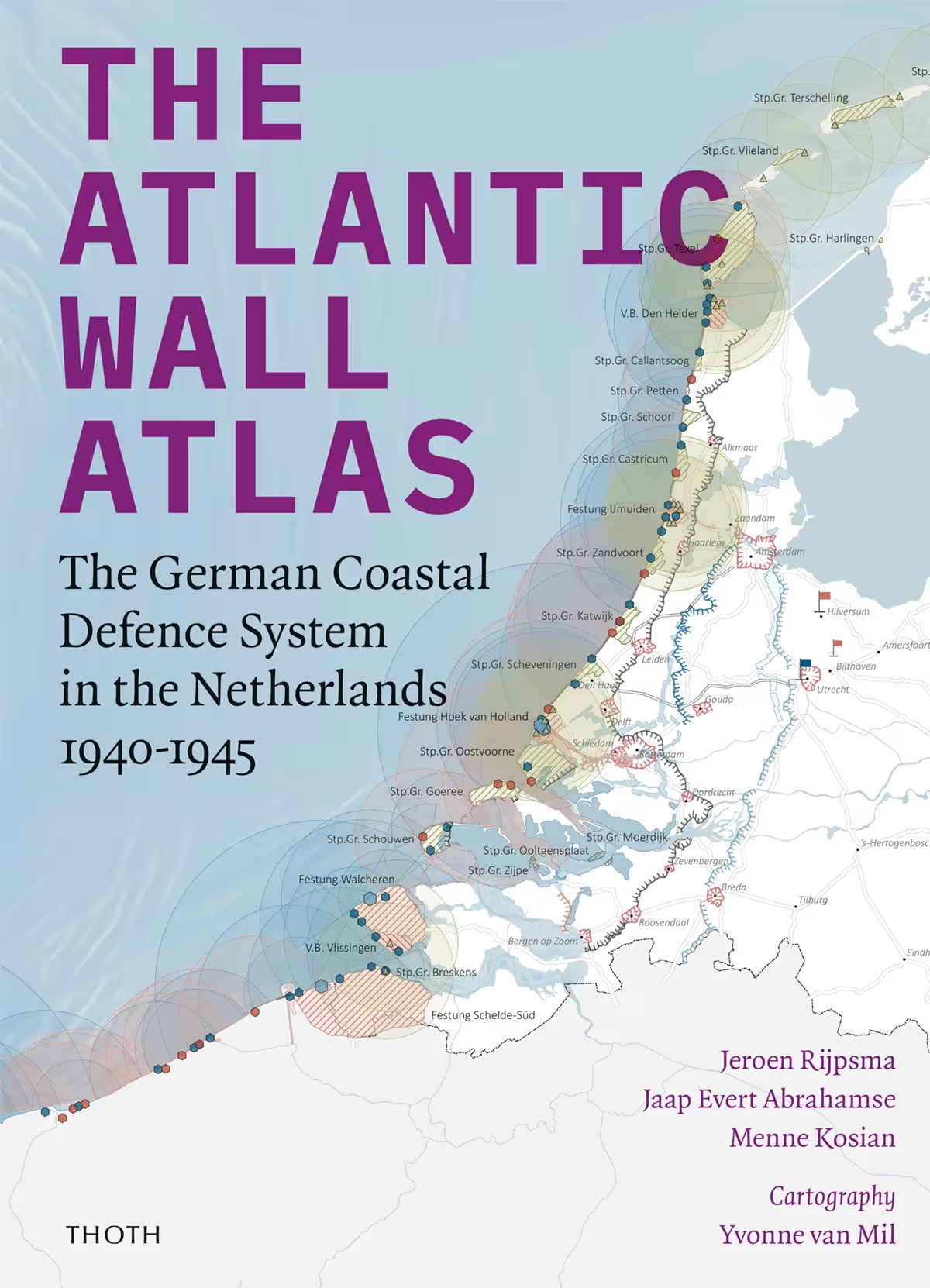
The Atlantic Wall Atlas has now been translated into English and published by THOTH Publishers.

Kids watch the demolition of the Atlanticwall in Vlissingen
Atlantic Wall Atlas
Jaap Evert Abrahamse (senior researcher at the Cultural Heritage Agency of the Netherlands and co-author of the atlas): Between 1940 and 1945, the west coast of continental Europe formed the border of Hitler’s Third Reich. Along that border, a defensive line was constructed, running roughly from the North Cape to the Pyrenees. From 1942 onwards, this line was expanded into what became known as the Atlantic Wall. The entire system was built in a short period of time and was continually adapted due to the course of the war and rapid technological innovations. The Atlantic Wall Atlas makes the functioning of the German defensive and offensive systems that were connected to this line comprehensible. We do this at various scale levels. To properly understand how the system worked, it is important to interpret the different components of the line in a European context. At a European level, contact will be sought with other countries to explore how cooperation can be taken forward. After all, this concerns cross-border heritage of the Second World War. That is why the book has been translated.
The atlas consists of a general introduction, descriptions of various aspects of the Wall based on detailed maps, and a final reflection on the afterlife of the Atlantic Wall and its relics. The maps are interspersed with photographs, some never previously published, that illustrate how the German occupiers shaped the Dutch coastal landscape to suit their own purposes.
Vision
The Vision for the Atlantic wall aims to ensure that important heritage values and structures of the line are preserved in the long term. The vision calls for careful handling of the remains. The most important means to achieve this is not always formal protection. Above all, taking existing remnants into account in government environmental and spatial planning policy is crucial. It is therefore important to pay attention to preservation in spatial visions and plans. At the same time, it is important to give historic defensive structures a function. The use of military structures usually also implies long-term preservation. Bunkers are often used as storage or training spaces, education centres, holiday homes, or tank ditches are used for water storage.